> For the complete documentation index, see [llms.txt](https://support.caspen.com/llms.txt). Markdown versions of documentation pages are available by appending `.md` to page URLs; this page is available as [Markdown](https://support.caspen.com/integrations/google/set-up-google-calendar-integration.md).
# Set up Google Calendar integration
Connect Google Calendar so you can view Caspen appointments, activities, classes, and busy times in Google Calendar.
## Overview
Connect your Google Calendar to Caspen so your Caspen calendar events appear in Google Calendar and stay up-to-date as you make changes in Caspen.
When connected, Caspen will create or update events in Google Calendar for:
* Appointments (including group appointments)
* Activities
* Classes
* Busy times
{% hint style="warning" %}
**Important note:**
* This is a **one-way sync** from Caspen to Google Calendar. If you need to make changes to your calendar events these changes should be made in Caspen. Changes made in Google Calendar do not sync back to Caspen.
* When you connect, Caspen creates a calendar called **Caspen** in your Google Calendar. We recommend you **do not rename** this calendar to keep your Google Calendar sync running smoothly.
{% endhint %}
***
## Connect your Google Calendar
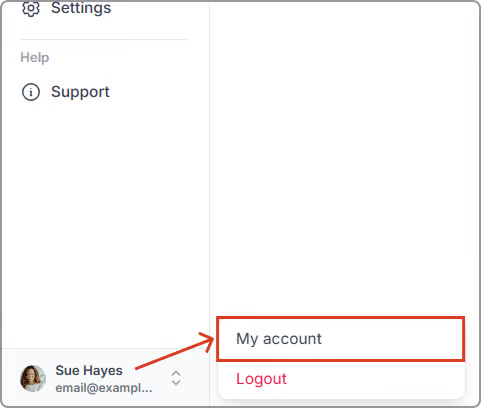
1. In Caspen, click your name in the bottom-left corner, then click **My account**.
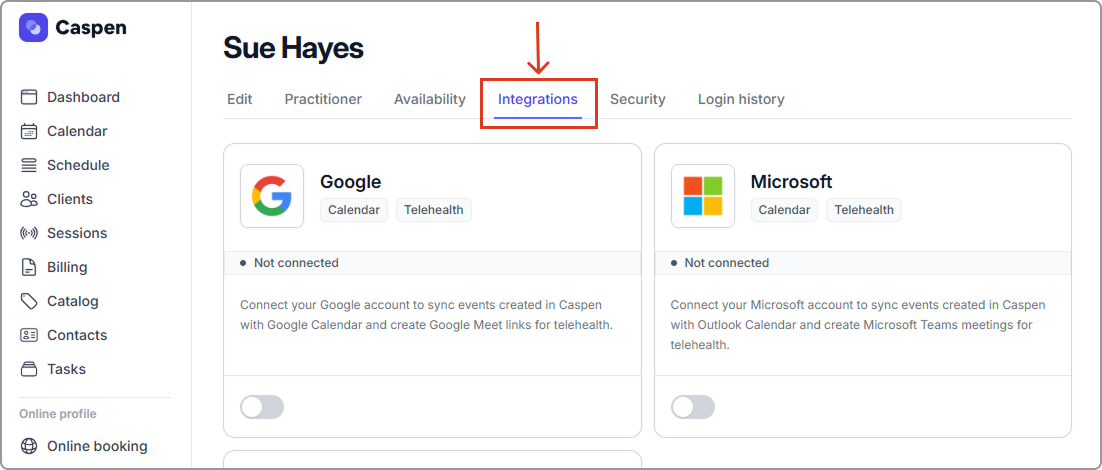
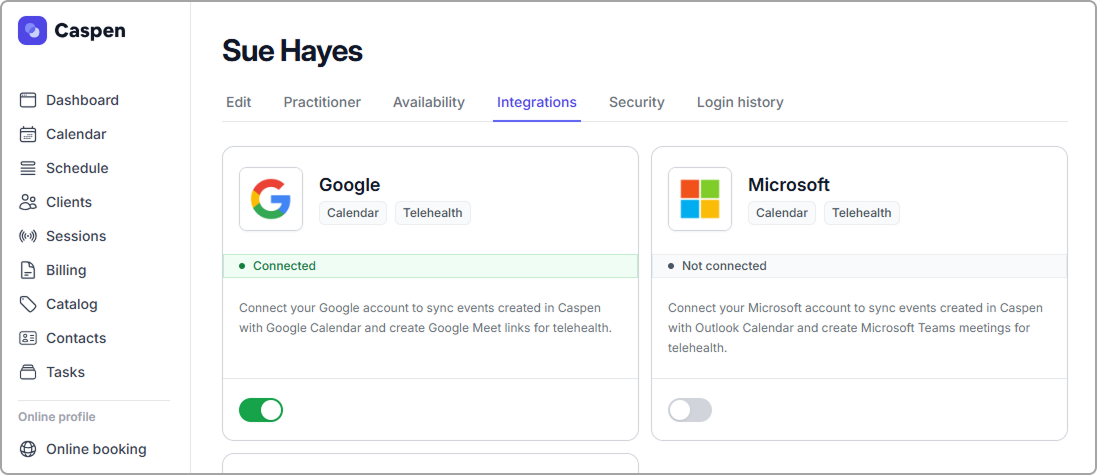
2. Open the **Integrations** tab.
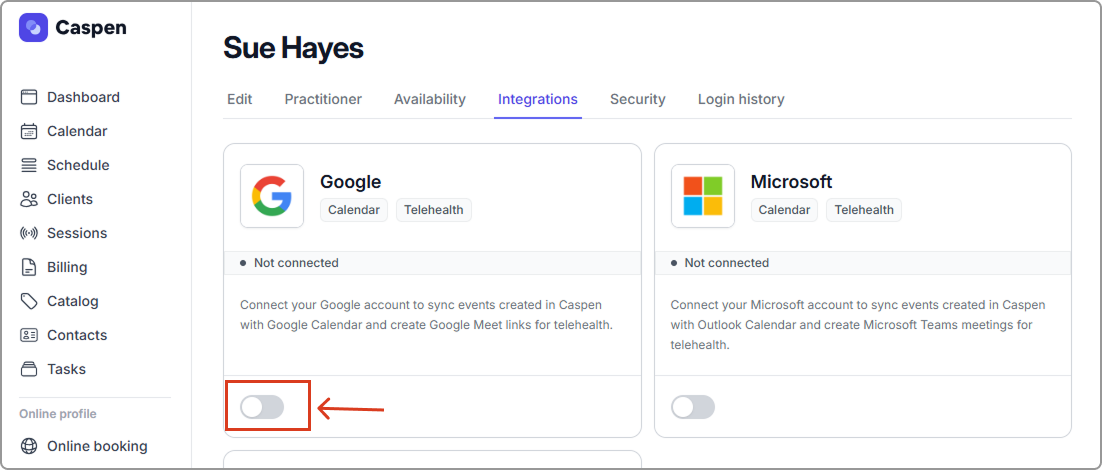
3. Find the **Google** **integration** and toggle it on.
4. Choose how far back you want to sync existing events:
* **From now onwards** (only sync future events)
* **From 7 days ago** (sync the past week and future events)
* **From 30 days ago** (sync the past month and future events)
5. Click **Connect**.
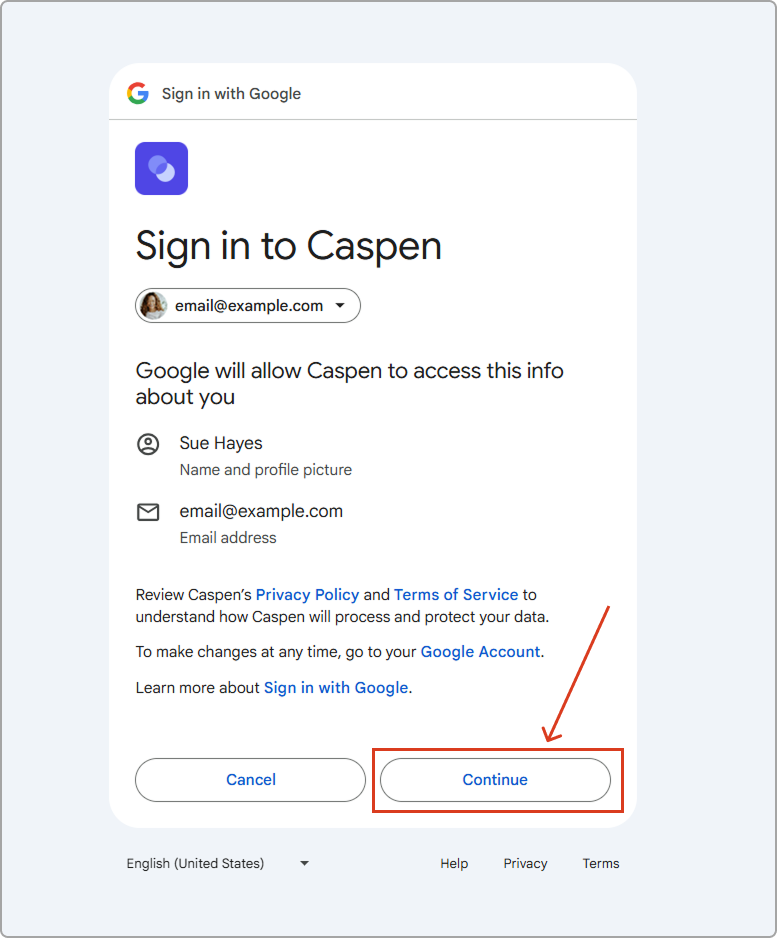
6. Google will open. Sign in, or if you are already signed in, choose the Google account you want to connect.
7. Click **Continue** to allow Caspen access.
8. Make sure calendar access is selected, then click **Continue**.
9. You will be redirected back to Caspen. The Google integration will show **Connected**, and you have now connected Caspen to your Google Calendar.
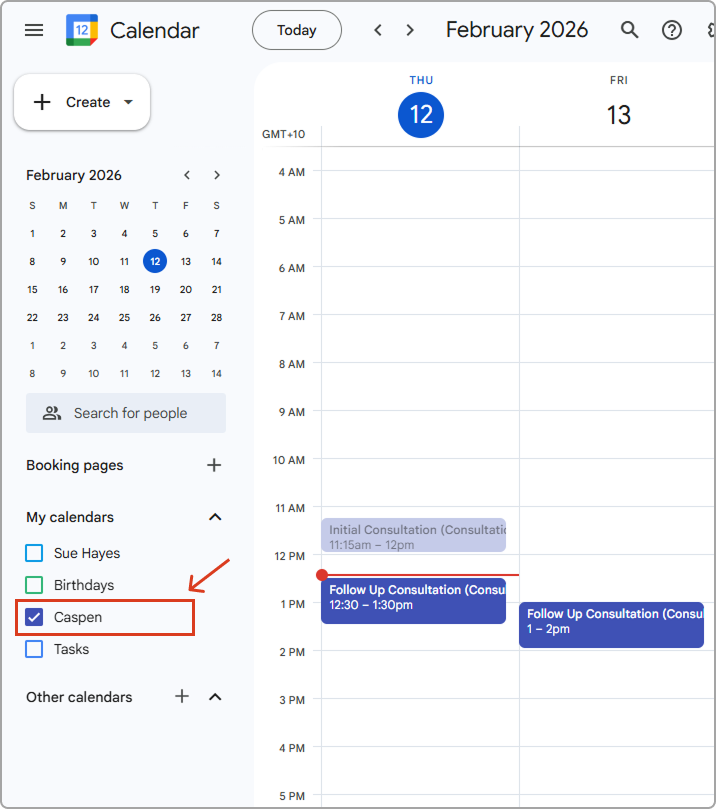
In Google Calendar, you will see **Caspen** under **My calendars** (you may need to refresh the page).
Caspen will start syncing your events straight away. If you have a lot of existing events, the first sync may take a few minutes. After that, changes you make in Caspen usually show up in Google Calendar quickly.
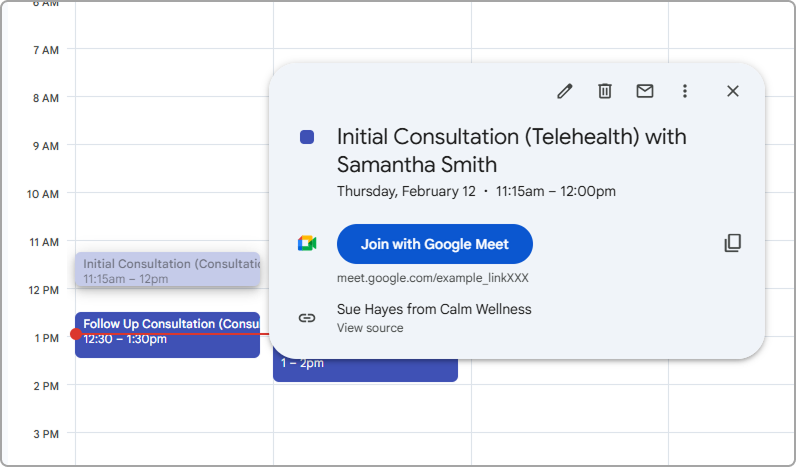
**Google Meet** will also be available automatically.
***
## Open an appointment in Google Calendar
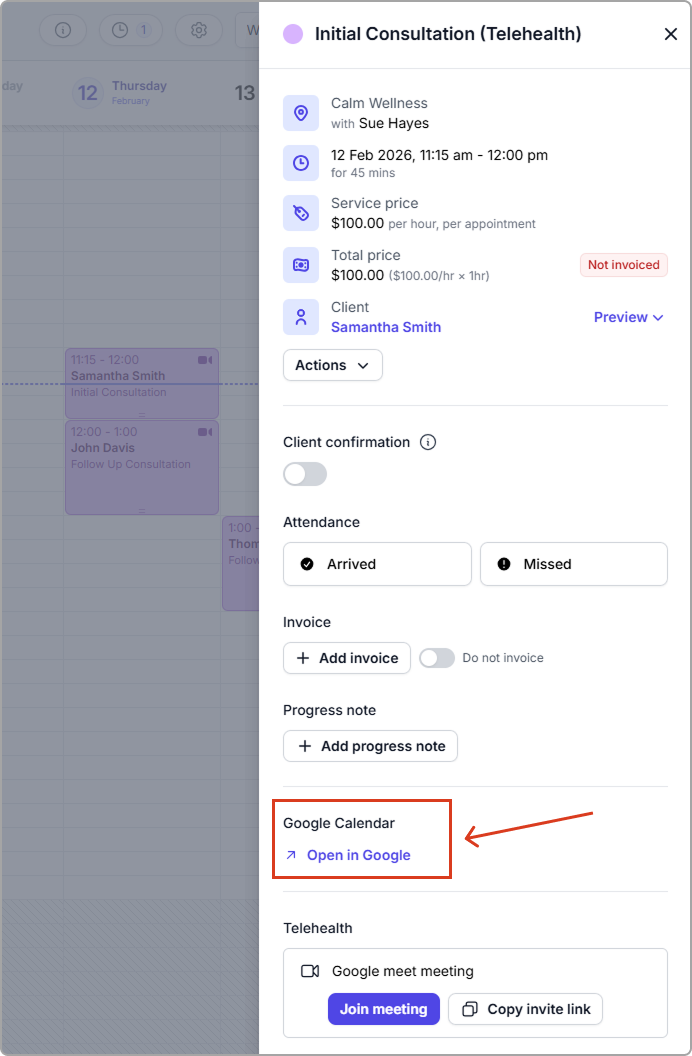
Click an appointment in your Caspen Calendar, then click "**Open in Google**" to open it in Google Calendar.
***
## Disconnect Google Calendar
To disconnect your Google Calendar from Caspen:
1. In Caspen, click your name in the bottom-left corner, then click **My account**.
2. Find **Google Calendar** and toggle it off.
3. Click **Disable** to confirm. The integration will show **Not connected**.
When you disconnect:
* The **Caspen** calendar is removed from your Google Calendar view (you may need to refresh the page).
* Your Caspen appointments remain unchanged in Caspen.
> **Important note:** Do not manually delete the Caspen calendar or its events in Google Calendar. Use Caspen to disconnect so the integration can be reconnected cleanly later if needed.
***
## Frequently asked questions
Why is the location missing in Google Calendar?
If an appointment is showing in Google Calendar without a location, it usually means the Caspen location does not have an address saved.
Google Calendar can only display a location if Caspen includes an address in the synced event. If the location has no address, the appointment will still sync, but the location field may be blank. \
\
To fix this for future appointments, add an address to your location in **Settings** → **Locations**.
Note: Updating the address won’t change past events already synced.
What happens if I delete a Caspen event in my Google Calendar by accident?
The appointment or class will still be visible in Caspen. However, Caspen can no longer update that event in Google Calendar because it has been removed. If you try to open it from Caspen using **Open in Google**, Google may show an error like “Could not find the requested event”.
What happens when I cancel an appointment or class in Caspen?
It will still appear in Google Calendar, but the title will be prefixed with **\[canceled]**. If you uncancel it later, the prefix is removed.
Are buffer times included?
No. Buffer times do not sync to Google Calendar.